
I recently presented at Las Vegas MoneyShow on the energy transition. I was later interviewed on the topic on the Financial Sense podcast (link). This article highlights the major points made in that presentation and subsequent interview.
The concept of the “energy transition” emerged after the 1973 oil crisis and was widely popularized by President Jimmy Carter. It refers to the global shift from fossil fuels to renewable energy sources, aiming to reduce greenhouse gas emissions and combat climate change. This transition is driven by government policies, international agreements like the Paris Agreement, and technological advancements in energy storage and efficiency.
The U.S. has previously undergone an energy transition. As coal consumption began to ramp up from about 1850, it ultimately supplanted wood as the primary source of energy for Americans.
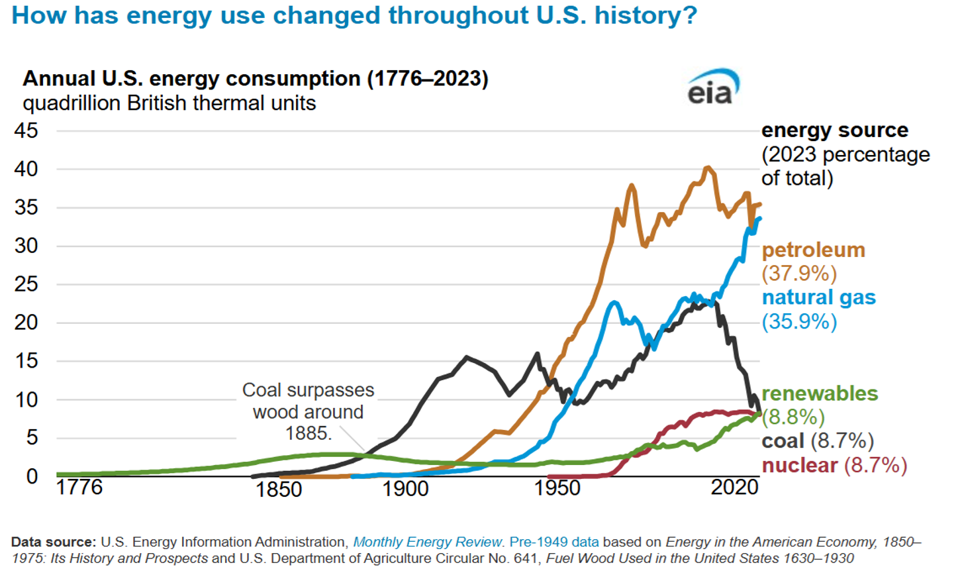
During the previous century, the use of oil and natural gas steadily increased. As that happened, coal consumption at first declined, before resurging in the second half of the century. Nuclear power began to ramp up in the mid-1960s.
One could argue that there was a partial transition from coal to oil and natural gas during the previous century, before coal consumption once more began to rise. That pattern has repeated this century as coal consumption is once more on the decline. However, that decline is largely a result of natural gas displacing coal at power plants, with the rise of renewable energy making a secondary contribution.
This pattern shows that there is a transition from coal, but it’s not an overall transition from fossil fuels to renewables which is what many believe. In fact, global energy demand has consistently grown faster than renewable energy has increased.
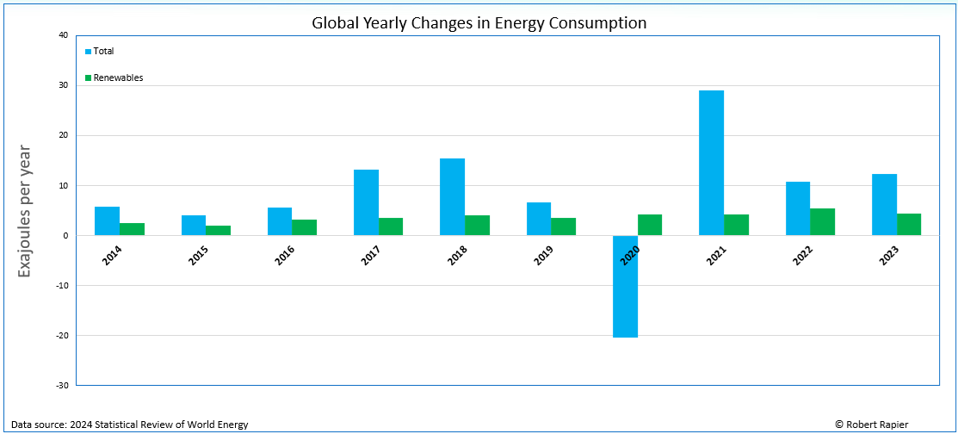
The data shows that in nine of the past ten years, overall energy demand outpaced the ability of renewables to keep up with that demand. The only exception was in 2020 when the COVID-19 pandemic dramatically impacted energy production.
These trends have important implications. If renewable energy isn’t keeping up with or even substantially gaining on overall energy demand growth, then other energy sources have to make up the deficit. That has meant that fossil fuel growth — and subsequently global carbon dioxide emissions — continue to rise.
Thus, what has happened thus far isn’t the energy transition some have pictured. Coal consumption is on the decline, but overall fossil fuel consumption continues to grow. As a result, some have referred to the current situation as an “energy expansion” rather than an “energy transition.”
The reason this is important is that energy policies need to reflect stark realities. It is fine to pass policies that encourage and incentivize an energy transition. But if policies are put in place that presuppose an energy transition — and that transition doesn’t materialize — it can set up a future of energy shortages and skyrocketing energy prices.
In conclusion, while the concept of an energy transition remains a critical goal in the fight against climate change, the reality is that we are still far from achieving a true shift away from fossil fuels. The data shows that global energy demand continues to outstrip the growth of renewable energy, leading to a continued growing reliance on fossil fuels and rising carbon emissions.
As such, it is crucial for energy policies to be grounded in the realities of our current energy landscape. Policymakers must balance the drive for renewable energy with the practical needs of maintaining a stable and affordable energy supply. Otherwise, we risk facing significant energy shortages and economic disruptions in the years to come. The transition will require not just ambition but also pragmatism and careful planning to ensure a sustainable energy future.
Follow Robert Rapier on Twitter, LinkedIn, or Facebook
