
The energy sector came roaring back in the third quarter of 2026. After finishing at the bottom of the sector rankings in Q2, Energy gained 16.5% in Q3, easily outpacing every other sector and the S&P 500’s 2.0% return. That was a remarkable turnaround, but the headline sector number doesn’t fully capture what happened beneath the surface, because returns varied dramatically across different parts of the energy business.
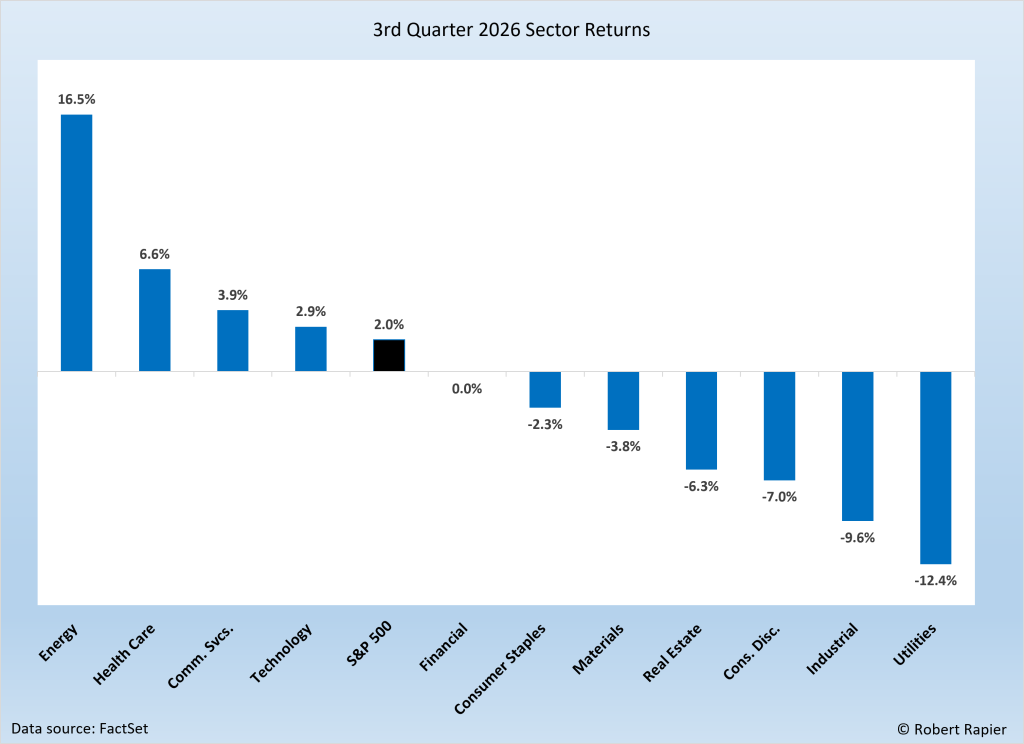
The biggest winners weren’t the companies producing oil and gas. They were the companies turning crude oil into gasoline, diesel, jet fuel, and other petroleum products. The three large independent refiners I routinely track—Marathon Petroleum, Phillips 66, and Valero Energy—produced an average return of more than 52% during the quarter. Meanwhile, integrated oil companies gained about 20% on average, exploration and production companies averaged roughly 13%, and the broader midstream group gained about 12%.
That makes refining the most interesting story from Q3, and it also helps explain an apparent contradiction in today’s energy markets. The world can have adequate supplies of crude oil while simultaneously experiencing a shortage of refined products, particularly diesel. As I recently discussed in greater detail, refining capacity rather than crude availability has increasingly become the constraint.
Refiners Take the Lead
Marathon Petroleum led the Big Three refiners with a 55.1% return during Q3, while Phillips 66 gained 51.8% and Valero Energy returned 49.4%. Those would be outstanding annual returns, much less gains delivered in a single quarter.
The key to understanding these moves is that refiners don’t necessarily benefit from high crude oil prices in the same way producers do. Their profitability depends primarily on the difference between the cost of crude oil and the value of the gasoline, diesel, jet fuel, and other products they manufacture from it.
Those refining margins, commonly called crack spreads, widened dramatically as disruptions to Russian and Middle Eastern refining capacity tightened the global market for transportation fuels. By September, diesel margins had reached extraordinary levels, while U.S. refiners were operating at very high utilization rates in an effort to meet demand.
The strength wasn’t limited to the Big Three. PBF Energy gained nearly 70% during the quarter, CVR Energy rose almost 86%, and HF Sinclair gained 55%. Those results underscore how broad the refining rally became, although I generally focus on Marathon, Phillips 66, and Valero because their size and operations make them better representatives of the U.S. refining industry.
There is an important caution embedded in these returns. Refining is notoriously cyclical, and unusually high margins eventually attract a supply response, reduce demand, or disappear as disrupted capacity returns. Strong margins could persist if global diesel supplies remain constrained, but investors buying refiners after 50% quarterly gains should recognize that they are paying for a considerably different outlook than they were three months ago.
Integrated Majors Deliver Across The Board
The integrated majors also enjoyed an excellent quarter, although their gains were much less spectacular than those of the refiners. The five companies I track produced an average Q3 return of 19.9%, and each generated a double-digit gain.
Chevron led the group with a 24.3% return, followed closely by Shell at 23.7%. BP gained 20.5%, ExxonMobil rose 19.8%, and TotalEnergies returned 11.2%.
The advantage of the integrated model was especially evident during the quarter. These companies have substantial upstream exposure when crude oil prices rise, but they also own refining and other downstream assets that can benefit when product margins expand. That diversification provides multiple ways to generate cash flow, and Q3 offered favorable conditions on both sides of the business.
This group has also become more disciplined about capital allocation than it was during earlier commodity booms. Stronger balance sheets, restrained spending, dividends, and share repurchases have helped turn the integrated majors into more durable cash-generating businesses, even though their earnings will always retain significant exposure to commodity cycles.
Oil And Natural Gas Producers Diverge
Exploration and production companies also performed well overall, gaining about 13.1% on average in my sample, but that figure masks one of the quarter’s most interesting divergences. Companies with greater exposure to oil generally performed much better than many of the natural-gas-oriented producers.
Among larger oil producers, SM Energy gained 30.2%, APA Corporation rose 28.4%, Cenovus Energy gained 25.9%, ConocoPhillips returned 21.2%, and Canadian Natural Resources gained 20.2%. Suncor Energy also rose more than 27%, while Equinor gained more than 33%.
Natural gas told a different story. U.S. natural gas futures declined 7.6% during Q3 and finished the quarter just above $3 per million Btu, extending what has been a difficult year for gas prices. That weakness showed up in several gas-heavy producers: Comstock Resources fell 17.4%, EQT lost 8.4%, Expand Energy declined 7.2%, Advantage Energy fell 5.7%, and Antero Resources lost 5.0%.
That split is an important reminder that “Energy” isn’t a single commodity trade. Oil and natural gas have different supply-and-demand dynamics, and companies exposed to one can perform very differently from companies exposed to the other even when they occupy the same broad market sector.
Midstream Was Really Two Different Markets
The midstream group returned about 12.0% on average, but here again the average conceals a striking divergence. The strongest performers weren’t the large North American pipeline operators most investors normally associate with midstream. They were tanker and marine transportation companies.
Dorian LPG jumped 61.9%, Frontline gained 51.2%, Teekay Tankers rose 50.1%, Nordic American Tankers gained 48.1%, and DHT Holdings advanced 45.6%. Disrupted trade routes and changes in global petroleum flows increased both voyage distances and the value of available shipping capacity, creating an unusually favorable environment for tanker operators.
Traditional pipeline companies had a much harder quarter. Enbridge declined 13.1%, TC Energy fell 11.9%, Williams Companies lost 7.9%, and Kinder Morgan dropped 4.8%, while Enterprise Products Partners and ONEOK were modestly negative. Those businesses remain much less sensitive to commodity prices than producers or refiners, but their income-oriented characteristics can leave them vulnerable when interest rates rise and investors can obtain increasingly attractive yields elsewhere.
What Comes Next
Q3 demonstrated once again how quickly leadership can rotate within the energy sector. Energy went from the worst-performing S&P 500 sector in Q2 to the best performer in Q3, but even that dramatic reversal understates what happened at the company level. A refining stock could gain more than 50% while a natural gas producer lost double digits, even though both were classified as Energy.
Going into the fourth quarter, global diesel markets remain tight, and disruptions to refining capacity have given U.S. refiners an unusually strong competitive position, but these conditions will not persist indefinitely. Oil producers likewise remain highly sensitive to geopolitical developments, while natural gas producers need a stronger pricing environment to close the performance gap that opened during Q3.
There is a broader lesson here as well. Energy investing is often discussed as though investors are simply making a bet on the price of oil, but Q3 showed why that view is far too simplistic. Producers, refiners, integrated majors, pipelines, LNG operators, and tanker companies occupy very different positions in the energy value chain, and the forces that benefit one can sometimes hurt another. Understanding those differences was particularly valuable in Q3, when Energy led the market, but refiners stole the show.
Follow Robert Rapier on LinkedIn or Facebook
