
U.S. oil production has increased by 21% over the past five years. According to data from the Energy Information Administration (EIA), earlier this month U.S. oil producers set a new annual production record.
This increase is being driven by a surge of production in a handful of states. I thought it might be of interest to look at which states are contributing the most to U.S. oil production, and how much production has changed over the past five years.
Total production for 2023 is not yet available, but monthly numbers are available through September (as well as weekly number through mid-December). I averaged oil production over the past 12 months (October 2022 through September 2023) for the entire U.S., as well as for every state that reported oil production in the past five years. (See the data source here).
Here were the Top 11 oil-producing states over the past year. Production is in million barrels per day (BPD).
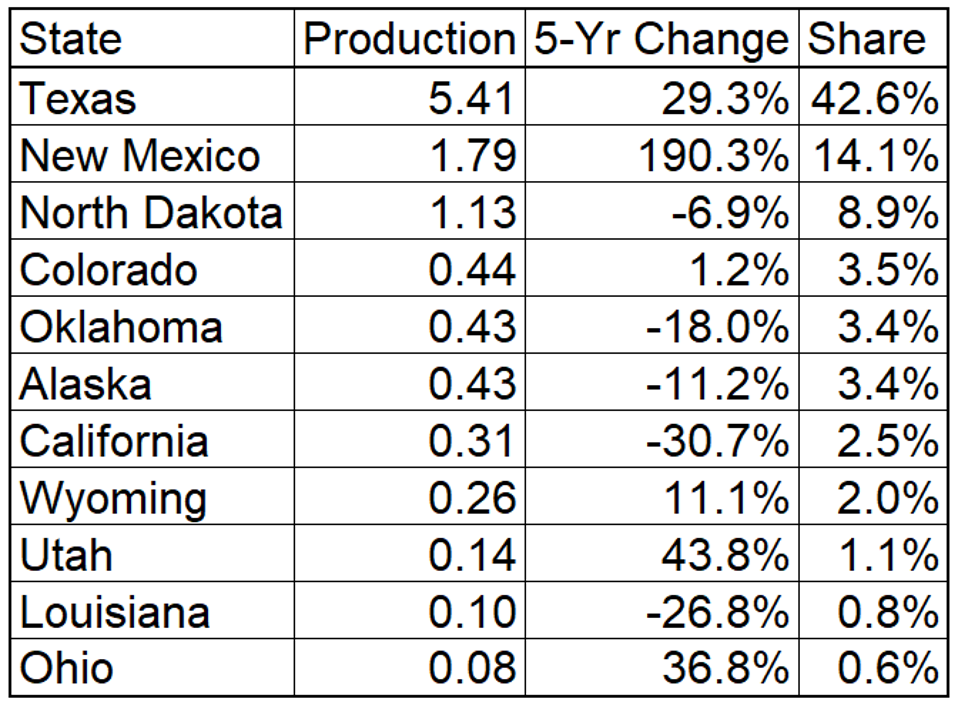
Texas is contributing the largest share to the production record at 42.6% of the U.S. total. This is primarily due to surging production in the Permian Basin. The Permian Basin effect can also be seen in New Mexico’s incredible 190% surge over the past five years. New Mexico is now the country’s second-leading oil producer.
Production in North Dakota is still above one million bpd, but oil production there is down from its peak. However, North Dakota production has been increasing this year, and is up 17% over the past year.
Five of the eleven states shown have seen production decline over the past five years. If you wonder why I listed eleven states, it was primarily to include Ohio, which has not historically been thought of as one of the leading oil producers. Ohio’s production is still modest relative to states like Texas and New Mexico, but it is growing due to development in the Utica Shale in the Appalachian Basin.
A hundred years ago, California was the country’s top oil producer. In the late 1980s, California was still producing over one million bpd. But production has been in steady decline there, due to politics and unfavorable geology that rendered hydraulic fracturing less appealing than in midwestern oil and gas formations. Over the past five years, California’s 30.7% decline in oil production is the largest among top producers.
One major area of production that I didn’t consider here was federal offshore production in the Gulf of Mexico. Over the past year, that contributed another 1.84 million bpd, which is 9.3% higher than it was five years ago (and just under the record 1.898 million bpd level set in 2019).
That is my final Forbes column for 2023. Thank you for reading. Happy New Year, and may your 2024 be healthy, happy, and prosperous.
Follow Robert Rapier on Twitter, LinkedIn, or Facebook
