
This article is the fourth in a series on the BP Statistical Review of World Energy 2022. The Review provides a comprehensive picture of supply and demand for major energy sources on a country-level basis. Previous articles covered overall energy consumption, carbon dioxide emissions, and petroleum supply and demand.
Today, I want to cover the production and consumption of natural gas.
In 2021, global natural gas consumption reached a new all-time high, surpassing the previous record set in 2019 by 3.3%.
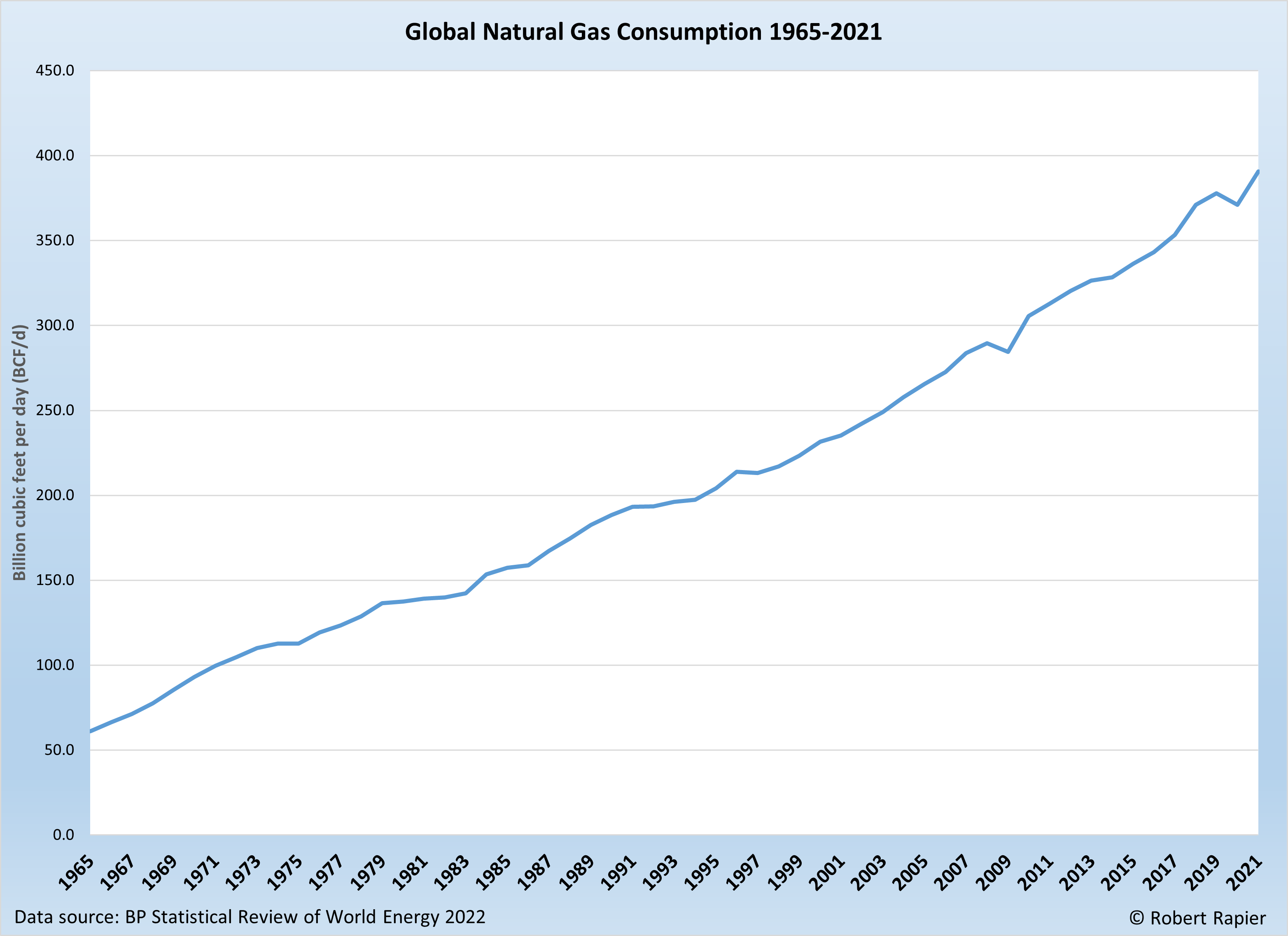 Natural gas is the cleanest-burning of the fossil fuels. It is also fastest-growing fossil fuel, with a global 2.2% average annual growth rate over the past decade.
In comparison, oil grew at a rate of 0.7% globally over the past decade, and coal grew globally at 0.1%. Looking ahead, natural gas is projected to be the only fossil fuel that will see substantial demand growth over the next two decades.
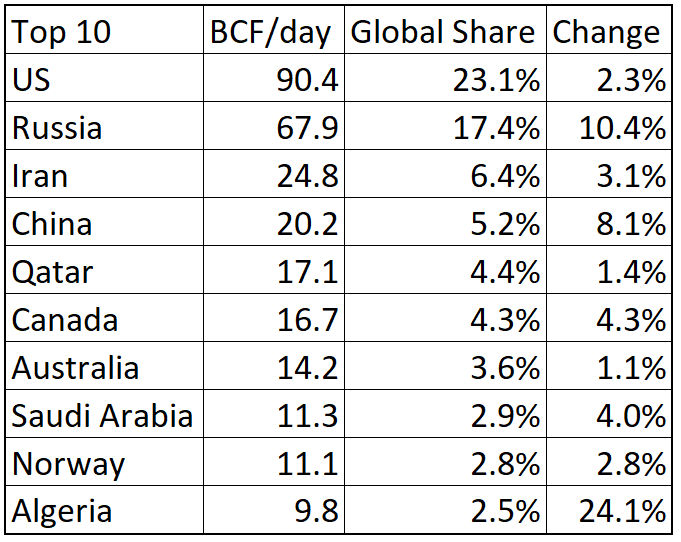
Over the past decade, the U.S. shale gas boom propelled the U.S. into the global lead among natural producers. In 2021, the U.S. set a new all-time high for natural gas production. For the year, the U.S. held a commanding 23.1% share of global natural gas production, ahead of Russia (17.4%) and even the entire Middle East (17.7%).
The Top 10 producers of natural gas accounted for 72.6% of the world’s natural gas supply in 2021. U.S. production grew 2.3% last year to surpass 90 billion cubic feet (BCF) per day for the first time. U.S. production in 2021 was 91% higher than in 2005, when the shale gas boom was just getting started.
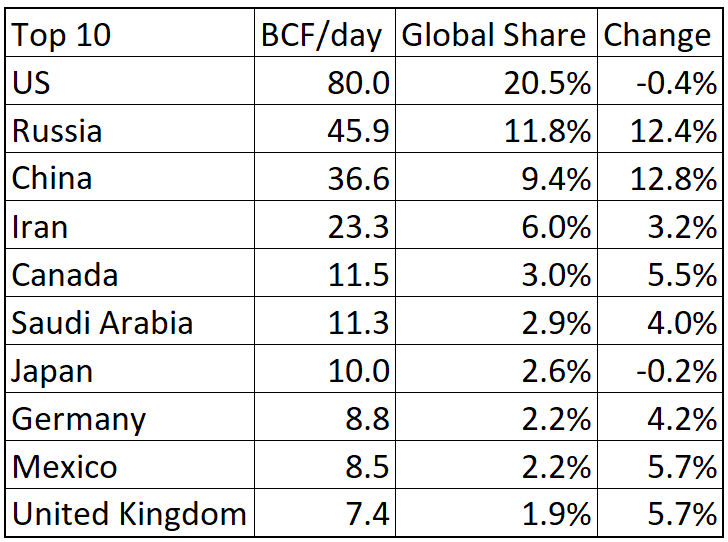
 The U.S. is also the world’s top consumer of natural gas. In fact, most of the leading producers are also the world’s leading consumers.
 The surge of natural gas production in the U.S. has also launched the U.S. into first place globally in natural gas liquids (NGL) production. The U.S. has a 44.8% global share of NGL production, with most of the NGLs destined for refineries or petrochemical production.
However, because the U.S. consumes most of the natural gas it produces, it lags two other countries in the export of liquefied natural gas (LNG), which is different than NGL. In 2021 Australia was in first place globally with a 20.9% share of LNG exports, followed by Qatar (20.7%), the U.S. (18.4%), Russia (7.7%), and Malaysia (6.5%).
But the U.S. is the world’s fastest-growing LNG exporter, with a 49.1% average annual growth rate over the past decade (and a 100% increase in LNG exports from 2019 to 2021). The U.S. is on a pace to become the world’s largest LNG exporter this year.
In the next installment, I will examine the world’s coal markets.
Follow Robert Rapier on Twitter, LinkedIn, or Facebook.
